
Introduction
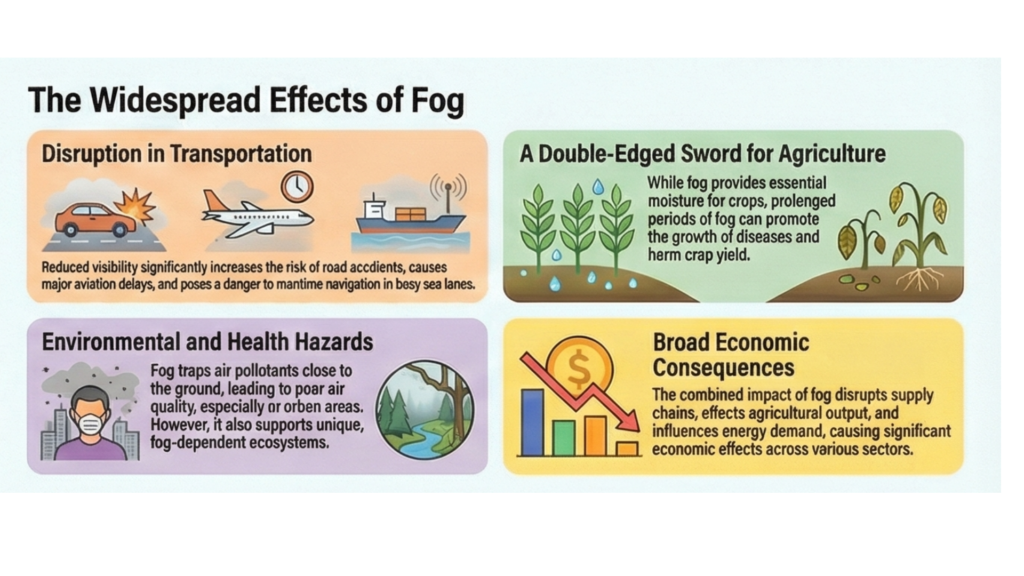
Every winter, large parts of India experience a familiar yet disruptive weather phenomenon: Fog. From delayed flights and stranded trains to massive traffic jams on highways, it brings daily life to a near standstill. While it may appear harmless at first glance, it is one of the most dangerous and economically damaging weather events during the Indian winter season.
In this article, we explain the science using India Meteorological Department (IMD) terminology, analyze why it becomes severe in winter, and explore its serious impact on aviation, railways, and road transport. We also include a practical road travel safety checklist to help travellers stay safe during conditions.
What Is Fog? (IMD Definition)
At its core, Fog is simply a cloud that has decided to visit the ground. It is a visible aerosol consisting of tiny water droplets or ice crystals suspended in the air near the Earth’s surface. For it to form, the difference between the air temperature and the Dew Point (the temperature at which air becomes saturated) must be less than 2.5°C.
According to the India Meteorological Department (IMD):
“Fog is the suspension of very small water droplets in the air near the Earth’s surface, reducing horizontal visibility to less than 1000 metres.
IMD Visibility Classification Table:
Intensity Visibility Range Impact Level Shallow Fog 500 meters up to 1000 meters Minor visual obstruction. Moderate Fog 200 meters up to 500 meters Slower traffic, minor delays. Dense Fog 50 meters up to 200 meters Major transport disruption. Very Dense Fog Less than 50 meters Zero-visibility conditions; hazardous.
The Mechanics: Why and How Does It Form?
To understand why your train is late, you have to understand the atmosphere. Fog isn’t random; it is a specific recipe of moisture, cooling, and calm winds.
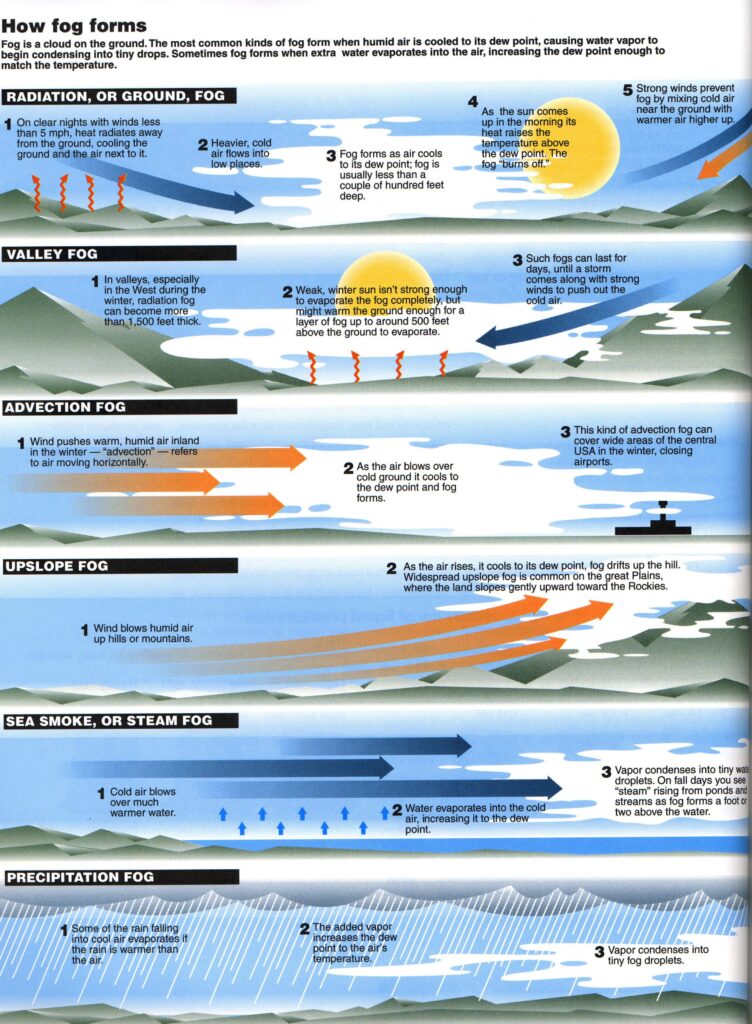
- Radiation Fog: This is the most common culprit in North India during winter. It happens overnight when the ground loses heat (radiates it away) into the atmosphere. If the air is moist and the wind is calm, this cooling causes the water vapor to condense into droplets.
- Advection Fog: This occurs when warm, moist air moves horizontally (advects) over a cold surface. Unlike radiation fog, this needs a bit of wind and can persist even during the day.
- The Inversion Layer: usually, air gets colder as you go higher. In winter, a “Temperature Inversion” traps cold, stagnant air (and pollutants) near the ground, with warmer air sitting on top like a lid. This prevents the fog from lifting.
- Pollution Factor: In urban areas, dust and smoke particles act as Hygroscopic Condensation Nuclei—surfaces for water to cling to. This turns standard fog into “Smog,” which is denser and unhealthier.
Why Is Fog So Common in India During Winter?
India’s winter climate creates ideal meteorological conditions for fog formation, especially over the Indo-Gangetic Plains and Central India.
Key Geographic Factors:
- Vast flat terrain
- Extensive river systems
- Moist agricultural land
- Rapid night-time surface cooling
Regions frequently affected include Punjab, Haryana, Uttar Pradesh, Bihar, Delhi NCR, Madhya Pradesh, and Rajasthan.
Airports located in open plains—surrounded by vegetation and low-rise infrastructure—are particularly vulnerable to persistent radiation fog.
In urban areas like Delhi, pollution plays a big role too. Particulate matter(PM2.5,PM10) acts as nuclei for droplets, making fog denser and more persistent—sometimes turning it into smog.
This year, calm winds, high humidity, and dropping temperatures have fueled widespread radiation fog, leading to those zero-visibility mornings we’re experiencing.
When Does Fog Occur and How Long Does It Last?
Seasonal Pattern:
- Primary season: November to February
- Peak intensity: December and January
Daily Timing:
- Fog generally forms after midnight
- Maximum intensity occurs between 0300 IST and 0800 IST
- Dissipation begins after sunrise due to surface heating
The peak “fog season” usually runs from mid-December to mid-February. The cycle is often diurnal; fog forms in the early hours (03:00 AM), peaks around sunrise (07:00 AM), and (hopefully) dissipates by noon as the sun heats the ground. However, during severe “Cold Day” conditions, the fog layer can refuse to budge for days.
Why Fog Persists Longer in Winter:
- Long nights
- Weak solar radiation
- Low sun angle
- Cold air trapping near the surface (Temperature Inversion)
Why Does Fog Form? (Scientific Explanation)
Fog forms when the air near the surface becomes saturated, meaning:
Air Temperature (T) falls to the Dew Point Temperature (Td)
Key Meteorological Parameters:
- Dew Point Temperature (Td): Temperature at which air becomes saturated
- Relative Humidity (RH): Percentage of moisture present in air
- Temperature–Dew Point Spread (T–Td):
- Fog likely when T–Td ≤ 1°C
Favorable Conditions for Fog:
- Clear skies (maximum radiational cooling)
- Calm or light wind (≤ 3 knots)
- High RH (≥ 85–90%)
- Moist ground surface
- Long winter nights
How Does Fog Develop? (Step-by-Step)
Radiation Fog (Most Common in India):
- After sunset, the Earth loses heat through longwave radiation
- Surface temperature drops rapidly
- Air close to the ground cools
- Temperature reaches the dew point
- Condensation forms microscopic water droplets
- Droplets remain suspended due to calm wind
- Visibility reduces drastically → fog formation
Fog dissipates once solar heating increases temperature above the dew point or when wind mixing occurs./
Types of Fog Observed in India (IMD Perspective)
1. Radiation Fog
- Forms on clear, calm winter nights
- Most common over northern and central India
- Primary cause of transport disruption
2. Advection Fog
- Warm, moist air moves over a colder surface
- Occurs near coastal areas
3. Valley Fog
- Cold air settles in valleys
- Common in hilly terrain
4. Evaporation Fog
- Cold air passes over warm water bodies
- Rare over Indian plains.
Impact on Aviation: Flying Blind
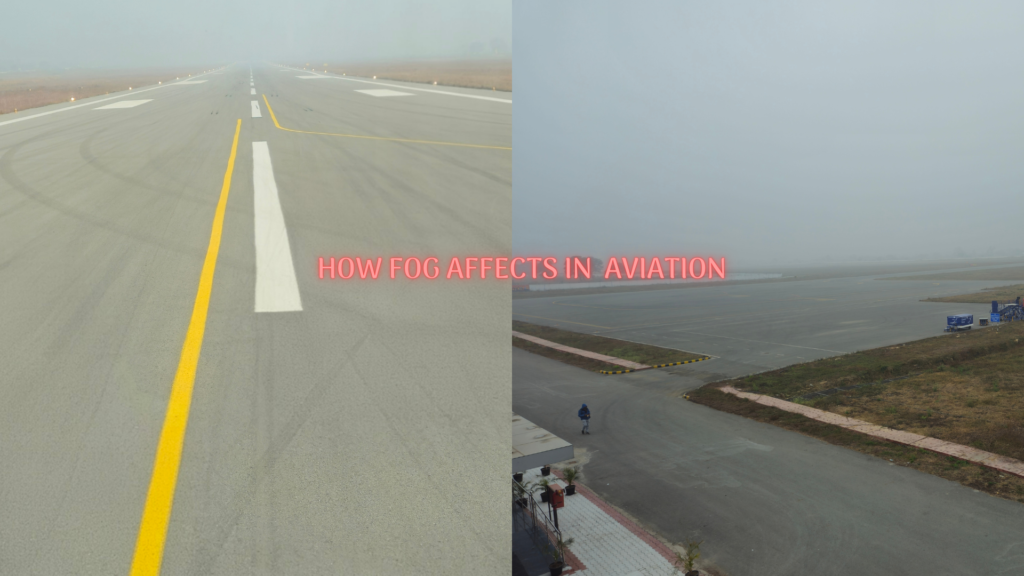
Fog is one of the most critical hazards in aviation meteorology.
Major Aviation Impacts:
- Sharp reduction in Runway Visual Range (RVR)
- Activation of Low Visibility Procedures (LVP)-When RVR drops below 800m, airports initiate Low Visibility Procedures (LVP).
- Flight delays, diversions, and cancellations
- Increased fuel consumption
- Crew duty-time exceedance
- Passenger congestion at airports
Important Aviation Terms:
- RVR (Runway Visual Range): Distance a pilot can see along the runway
- ILS (Instrument Landing System): Precision landing aid
- CAT I / II / III: Categories of ILS defining minimum visibility for landing
The Problem: Even if the plane can land in 50m visibility, it might not be able to taxi to the gate efficiently. furthermore, if the destination airport has clear weather but the departure airport has fog, the flight is stuck. This domino effect causes the massive cancellations we see in winter.
Airports without CAT II/III ILS face prolonged operational shutdowns during dense fog events.
In December 2025 alone, hundreds of flights have been grounded or delayed daily across North India. Airlines like IndiGo, Air India, and SpiceJet have issued repeated advisories, with cascading effects rippling to other routes. Passengers are left stranded, and operations strain under crew duty limits and turnaround delays.
Impact on Railways: The Iron Snail
The Indian Railways network is massive and heavily reliant on visual signals. When a locomotive pilot (driver) cannot see the signal from a safe braking distance, they have no choice but to slow down.
- Speed Restrictions: In dense fog, maximum speeds are often capped at 60 kmph or lower (down from 130 kmph) to ensure the train can stop if a signal is red.
- Fog-PASS Devices: To combat this, Railways have introduced the Fog Pilot Assistance System for Safety (Fog-PASS). This is a GPS-enabled handheld device that gives the pilot audio-visual alerts about approaching signals and level crossings before they are visible.
- The Delay Reality: Despite Fog-PASS, safety protocols mandate reduced speeds. When one train slows down on a busy track, every train behind it gets delayed, creating a backlog that takes days to clear.
Impact of Fog on Road Transport: the danger zone
While flights and trains get delayed, road transport faces the highest risk to life. Chain-reaction crashes (pile-ups) are a tragic hallmark of dense conditions on expressways.
- Reaction Time: At 80 kmph, your vehicle covers roughly 22 meters per second. In “Very Dense Fog” (<50m visibility), an obstacle might appear only 2 seconds before impact.
- Disorientation: Drivers often lose “spatial orientation” in whiteout conditions, drifting out of lanes or misjudging speed.
High-Risk Locations:
- National highways
- Expressways
- Rural roads without lighting
- River crossings and low-lying areas
Most fatal fog-related accidents occur during early morning hours.
Statistics show thousands of fog-related accidents annually, with fatalities rising in states like Uttar Pradesh and Bihar. High speeds, improper lights, and overtaking in low visibility compound the risks
Road Travel Safety Checklist During Fog
Planning a road trip? Always check IMD fog forecasts first—they’re lifesavers! Here’s a quick, friendly checklist to stay safe:
- Monitor Weather Apps: Use the IMD website or app for real-time dense/very dense fog alerts before starting.
- Delay if Possible: If very dense fog (0-50m visibility) is forecast, postpone non-essential travel—wait for sunrise when it often lifts.
- Prepare Your Vehicle: Ensure fog lights work, tires are good, and wipers/defrosters are ready.
- Drive Defensively: Reduce speed drastically, use low-beam headlights (not high-beams—they reflect back), and keep hazard lights on if stopping.
- Maintain Distance: Double or triple your following distance—fog distorts depth perception.
- Stay in Lane: Avoid overtaking; follow road markings or the vehicle ahead cautiously.
- Listen Up: Roll down windows slightly to hear horns or approaching vehicles.
- Pull Over Safely: If visibility drops too low, find a safe spot off the road, turn on hazards, and wait it out.
- Avoid Distractions: No phone, low music—stay fully alert.
- Post-Trip Check: After foggy drives, rest up; fatigue adds risk.
Following these can make all the difference—drive safe, folks!
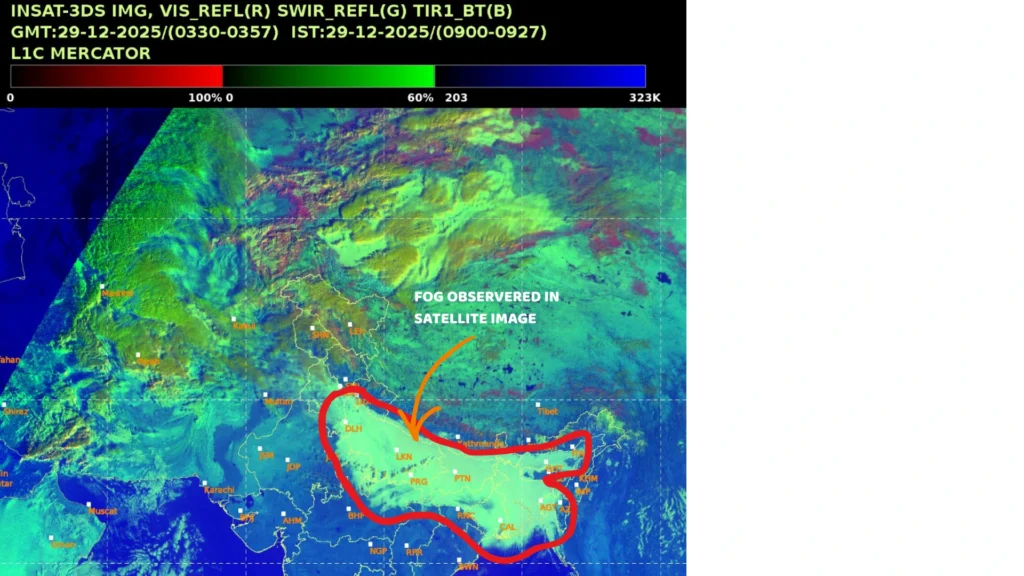
how common people see fog in satellite images
There are certain websites where you can see Fog in Satellite Images:
- SATELLITE SERVICES | India Meteorological Department-IMD official page
- Weather Satellite & Radar Map | Zoom Earth
- https://www.accuweather.com/
- https://www.meteoblue.com/- In this URL go to Weather Maps and you can see Fog affecting Areas in white patches.
Wrapping Up: Staying Ahead of the Fog
Dense Fog is a winter staple in India, but understanding IMD terminology and its impacts helps us navigate better. From radiation formation to disruptions in aviation, railways, and roads, it’s a reminder to prioritize safety.
As we wrap up 2025, keep an eye on IMD updates—fog might linger through the holidays. If you’re traveling, plan extra time and stay informed.
Safe journeys, everyone! If you’ve got fog stories or tips, share in the comments—I’d love to hear. Stay warm and visible out there!
Bonjour à tous !
Je suis fasciné par cet article très détaillé sur les problèmes de brouillard hivernal en Inde. Cela m’a fait penser à un aspect moins connu : l’impact des conditions météorologiques sur la santé cognitive.
Savez-vous que le “brain fog” (brouillard mental) peut être exacerbé par certains facteurs environnementaux comme le smog hivernal ? Je suis tombé sur une analyse intéressante à ce sujet sur https://mindbodyneurology.com/peptides-and-brain-fog-integrative-neurology/ qui explore les solutions neurologiques intégratives.
Est-ce que l’IMD étudie également ces effets secondaires moins visibles du brouillard sur la santé publique, notamment chez les personnes sensibles ? Peut-être que des peptides spécifiques pourraient atténuer ces symptômes, comme suggéré dans la recherche que j’ai mentionnée.
Qu’en pensez-vous ? Avez-vous observé ce type d’effets pendant les épisodes de brouillard dense ?
Yes—indirectly. Winter fog itself doesn’t cause brain fog, but the conditions that come with it do: low sunlight, poor air quality, temperature inversion, disturbed sleep, and reduced activity due to cold. These lead to mental dullness, slow thinking, and fatigue. The effect is temporary and common in winter, especially in fog-prone regions, especially in the northern plain of India.