
A Surprising Truth About Weather Forecast Accuracy in India !
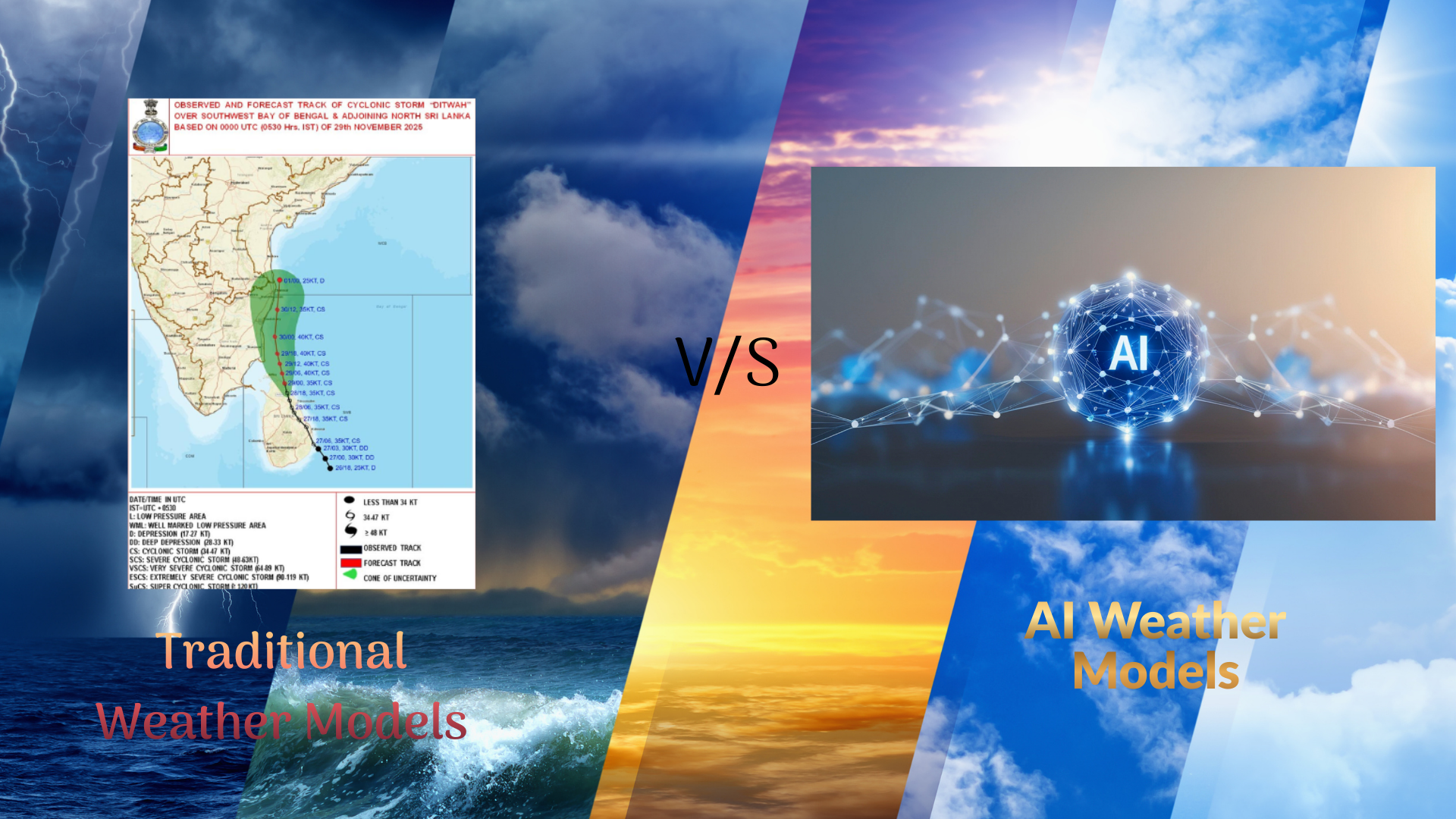
Is AI actually more accurate than traditional forecast models — the ones used by IMD and global weather agencies? Let’s explore the comparison of AI vs traditional weather models.
Did you know that even in 2026, a 24-hour weather forecast from India’s official weather agency — IMD — is only about 80–85% accurate on average? That’s right: for many common parameters like rainfall or temperature, current forecast systems get it right roughly 4 out of 5 times — but that still leaves a lot of room for surprises and uncertainty.
This number might sound solid — but in a country as vast and climatically diverse as India, where farmers plan sowing, businesses adjust logistics, and entire cities brace for cyclones based on forecast data, every percentage point truly matters.
Nowadays, an exciting frontier in weather science is taking shape: Artificial Intelligence (AI). AI promises faster, smarter, and more adaptive weather predictions than traditional models ever could. But the big question on the minds of weather enthusiasts across India is this.
As we compare AI vs traditional weather models, it becomes clear how technology is reshaping our understanding of forecasts.
In the ongoing debate of AI vs traditional weather models, understanding the strengths and weaknesses of each is crucial for making informed decisions.
Let’s dive deep and explore the heart of this weather forecasting revolution.
Understanding Traditional Weather Models
What Are Traditional Forecast Models?
Traditional weather forecasting relies on Physics-based Numerical Weather Prediction (NWP) models. These are giant mathematical systems that simulate the movement of air, moisture, heat, pressure and countless other weather factors using the laws of physics. Supercomputers process millions of data points from satellites, Doppler Radars, weather stations and balloons to produce forecasts. These models include widely known systems like the global GFS and ECMWF models.
In India, the India Meteorological Department (IMD) uses advanced NWP models developed in collaboration with research bodies such as IITM Pune and NCMRWF Noida, alongside its own data network. Over recent years, IMD’s forecast accuracy has steadily improved — especially for severe weather events and short-term forecasts. For example:
✔️ IMD’s 24-hour heavy rainfall forecast now hits near 80% accuracy
✔️ Thunderstorm forecasts are accurate around 86%
✔️ Heat/cold wave events are predicted right about 88% of the time
These improvements didn’t happen overnight. A combination of better satellite inputs, improved model resolution, and human expertise has lifted forecast reliability by roughly 40–50% in recent years.
The Bharat Forecast System (BFS) is IMD’s indigenous high-resolution weather model, with a spatial resolution of ~6 km, designed for precise district-level forecasting compared to Global Forecasting System’s spatial resolution of 12 km.
It has improved short-range forecast accuracy by about 10–15%, especially for heavy rain, thunderstorms, and extreme events.
Even with all that progress, here’s the reality:
Traditional models still struggle with hyper-local accuracy, especially in a tropical country like India with complex terrain, rapid weather changes, and a relatively sparse observational network.
Rise of AI in Weather Forecasting
What Makes AI Weather Models Different?
AI is transforming weather forecasting by learning directly from vast historical and real-time data instead of relying only on physical equations. With increasing computing power and better observations, AI models now deliver faster, high-resolution, and more localized forecasts, especially for short-term weather and extreme events.
What Makes AI Weather Models Different?
- Data-driven, not equation-driven – learn patterns from past weather
- Much faster – forecasts generated in minutes instead of hours
- Higher spatial detail – better local and city-level predictions
- Strong at short-range forecasts – rainfall, storms, heat waves
- Works alongside traditional models – used to complement systems like IMD’s NWP models
Some high-profile AI forecasting systems (like Google’s GenCast or NeuralGCM,Weather lab) have already shown incredible results. In controlled tests, GenCast outperformed traditional ensemble forecasts in 97% of key accuracy measures, especially for tropical systems and extreme temperatures.
AI is also more efficient: it requires less computational cost and time, a key advantage for resource-constrained countries like India.
AI v/S Traditional weather Models: Accuracy vs Reliability
Now let’s break down the strengths and limitations of both approaches — especially from an Indian viewpoint.
Accuracy
Traditional Models (IMD and global systems)
• Long-standing, physics-grounded.
• Very reliable for large-scale pattern predictions.
• High performance for 1–5-day forecasts (short-range forecasts).
• Better at capturing processes rooted in fundamental atmospheric physics.
In other words, traditional models are robust, dependable, and well-understood — hence licensed by national weather agencies worldwide.
AI Models
• Can outperform traditional models in specific scenarios.
• Extremely good at pattern recognition from historical data.
• Often better for short- to medium-range forecasts and certain variables.
• Some models show as much as up to 97% accuracy on benchmark tests — at least in research settings.
However — and it’s a big however — AI models are still developing. They work wonderfully when history is a good predictor of the future — but weather systems like intense cloudbursts or sudden cyclones i.e. Extreme Weather Events may not always follow patterns easily extractable from past data. That’s where physics-based models still shine.
Computational Speed & Efficiency
Traditional models require supercomputing power — often hours of number-crunching — before they can produce forecasts.
AI models, on the other hand, can produce predictions in minutes or even seconds, once trained. This speed opens doors for hyper-local forecasting and more frequent updates.
AI weather models like GraphCast and Pangu-Weather learn atmospheric patterns from historical data rather than solving physics equations, making them 10,000× faster than traditional NWP(Numerical Weather Prediction model ).
Handling Extremes and Uncertainty
Traditional models are better suited to:
✔️ Understanding the physical dynamics of Weather pattern.
✔️ Predicting extreme phenomena like cyclone intensity
✔️ Providing probability distributions for forecast confidence
AI sometimes struggles here — not because it’s worse, but because it hasn’t yet fully learned to mimic the nuanced physics behind such events. That’s why, even globally, meteorological departments haven’t replaced traditional models entirely with AI.
Real-World Indian Scenario
In India, where monsoon rains and cyclones define life, both approaches are being used side by side:
✔️ IMD uses cutting-edge NWP models with improved resolution systems like the Bharat Forecast System, raising spatial accuracy significantly — even down to local levels (up to 6km).
✔️ IMD is actively integrating AI and machine learning tools to boost forecast skill in areas like local rainfall and temperature predictions.
✔️ Private forecasting agencies and startups in India are building machine learning-based models showing promising short-term yields — sometimes 10–15% better than traditional forecasts for certain parameters.
But remember: AI in India is still limited by data availability, especially in rural regions where observational networks are sparse, and internet access isn’t universal. Many experts believe the future is hybrid — combining the best of both worlds.
So, Who’s More Accurate — AI or Traditional Models?
The honest answer:
Neither is absolutely superior yet. They each have strengths that make them invaluable.
Traditional models:
✔️ Extremely reliable for large-scale and physical processes
✔️ Trusted by national agencies
✔️ Better at extreme and dynamic weather patterns
AI models:
✔️ Often more efficient and faster for short- to medium-range forecasts
✔️ Excellent pattern recognition from big datasets
✔️ Rapidly improving with more data and hybrid models
In 2026, the best weather forecasts don’t come from one model alone — but from integrated systems that combine physics with AI, using each approach where it excels.
That’s becoming the future of Indian forecasting too! IMD’s roadmap includes hybrid systems that mix traditional and AI models for more accurate, real-time forecasting for farmers, disaster management teams, and everyday people.
Major Factors Affecting Accurate Weather Forecasting in India
- Complex Geography & Topography
Traditional physics-based models struggle with India’s diverse terrain at local scales; AI models help capture terrain-linked patterns but still depend on quality data. - Monsoon Dynamics & Variability
NWP models simulate physical processes of monsoon systems, while AI excels at recognizing repeating monsoon patterns, yet both face uncertainty during abnormal years. - Data Gaps in Observations
Traditional models degrade without dense observations; AI is highly data-hungry and performs poorly where historical data is sparse. - Rapid Urbanization & Local Effects
Urban heat islands occur at scales smaller than most NWP grids; AI models adapt faster to urban signals if trained on local datasets. - Atmospheric Pollution & Aerosols
Aerosol-cloud interactions are complex for physics-based schemes; AI can learn empirical relationships but lacks physical interpretability. - Model Resolution & Scale Limits
High-resolution NWP is computationally expensive; AI delivers high-resolution outputs quickly, though sometimes without physical consistency. - Initial Conditions & Data Assimilation
Traditional models rely on advanced assimilation systems; AI forecasts are sensitive to training bias and unusual atmospheric states. - Extreme Weather Prediction
NWP remains critical for cyclone track and intensity; AI improves short-term extreme rainfall and thunderstorm probability. - Ocean–Atmosphere Coupling
Physics-based coupled models remain essential; AI support is emerging but not yet fully reliable for ocean-driven systems. - Forecast Communication
Traditional forecasts are probabilistic and scientifically explainable; AI outputs need careful human interpretation before public dissemination.
What This Means for Weather Enthusiasts in India
If you love weather as much as we do, here’s what to keep in mind:
- Never rely on a single forecast source
- Compare IMD forecasts with global models like ECMWF or AI-enhanced systems for a broader view
- Track updates hourly — especially during Monsoon and Cyclone seasons
- AI is evolving rapidly — but it still needs good data and human meteorological expertise
The future? A world where your forecast app blends physics, AI, real-time observations, and local insights — giving you faster, smarter, and more accurate forecasts than ever before.
Conclusion
The integration of AI with traditional weather models marks a significant advancement in meteorology, particularly in regions that depend heavily on precise weather forecasts. This hybrid approach not only enhances the accuracy of predictions but also enables timely responses to changing weather patterns. As these technologies continue to evolve, they promise to empower individuals and organisations alike, transforming how we understand and prepare for weather events. Ultimately, the collaboration between AI and traditional methods heralds a new era in meteorological science, characterized by innovation and improved public safety.