
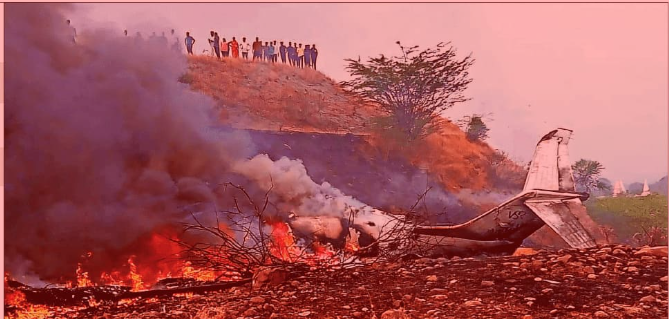
Tragedy in Baramati shook Maharashtra and the nation when a chartered aircraft carrying senior leader Ajit Pawar crashed while attempting to land at Baramati airport on 28th January2026. What was meant to be a routine short flight ended in a fatal aviation disaster, raising urgent questions about weather conditions, airport preparedness, and flight safety at small airfields. As initial reports pointed to marginal visibility and the absence of advanced landing aids, aviation experts and authorities began examining whether weather, infrastructure gaps, or operational decisions played a decisive role in the mishap.
The Fateful Morning: Weather and Visibility
Initial reports and eyewitness accounts have strongly indicated that poor visibility due to adverse weather conditions played a significant role in the mishap. At approximately 8:44 AM, when the Bombardier Learjet 45XR was attempting to land, the Baramati region was experiencing:
- Dense Fog: Visibility was severely restricted, reportedly dropping to below 800 meters. This is a critical factor for visual flight rules (VFR) operations and significantly impacts instrument flight rules (IFR) approaches, especially at smaller airfields.
- Mist and Haze: Compounding the fog, there was also a general atmospheric haze, which further reduced the pilots’ ability to visually acquire the runway.
- Low Cloud Ceiling: While exact figures are pending, pilots likely encountered a low cloud base, meaning the aircraft would have emerged from the clouds relatively close to the ground, leaving less time for visual correction during landing.
These conditions would have made a visual approach extremely challenging, if not impossible, and even an instrument approach would have demanded heightened precision and awareness from the flight crew.
Timeline of Events – 28 January 2026
Baramati airport is classified as an unregulated (uncontrolled) airfield, where air traffic–related information is provided by instructors and pilots from Flying Training Organizations (FTOs) operating at the aerodrome. There is no full-time licensed ATC service. According to the statement of the person on duty at the ATC position, the sequence of events unfolded as follows:
- 08:18 AM IST
The aircraft VT-SSK approached the Baramati aerodrome. - Approximately 30 Nautical Miles from Baramati
The aircraft received further traffic and landing-related information from Pune Approach. The crew was advised to land under Visual Meteorological Conditions (VMC), at the pilot’s discretion. - Weather Information Provided
On the crew’s enquiry regarding surface conditions, they were informed that:- Wind was calm
- Visibility was approximately 3,000 metres
- First Approach – Runway 11
The aircraft reported being on final approach for Runway 11, but shortly thereafter informed that the runway was not visible.
➤ The crew initiated a go-around during this first approach. - Second Approach Attempt
Following the go-around, ATC asked the aircraft to report its position. The crew again reported final approach for Runway 11. - Runway Visibility Exchange
- ATC requested confirmation of runway sighting.
- The pilot responded: “Runway not visible yet, will inform when the runway is visible.”
- A few seconds later, the crew reported that the runway was in sight.
- Landing Clearance
- At 08:43 AM IST, the aircraft was cleared to land on Runway 11.
- Notably, no readback of the landing clearance was received from the aircraft.
- Accident Occurrence
- At 08:44 AM IST, ATC personnel observed flames near the threshold of Runway 11.
- Emergency services were immediately activated and reached the crash site.
- Wreckage Location
The aircraft wreckage was found on the left side of Runway 11, abeam the runway threshold, indicating loss of control during the final phase of landing.
Baramati Airport and Meteorological Services: A Critical Gap?
The question about an official met office setup at the airport is pertinent. Baramati Airport is primarily a general aviation airfield and a flying training hub. While it has basic air traffic control facilities and a runway suitable for smaller jets, it does not typically host a full-fledged, independent Meteorological Office (Met Office) operated by the India Meteorological Department (IMD) or a dedicated Aerodrome Meteorological Office (AMO), as at larger international airports.
Instead, smaller airfields often rely on:
- Automated Weather Observing Systems (AWOS): These provide real-time data on wind, temperature, visibility, and cloud base.
- Pilot-Reported Weather (PIREPs): Information shared by other pilots operating in the vicinity.
- Forecasts from nearby larger airports: Meteorological forecasts issued for regions or larger airports like Pune (Lohegaon) are often used, which might not always perfectly reflect hyper-local conditions.
- ATC Observations: Air Traffic Controllers can provide observed visibility and cloud cover.
- The absence of a dedicated Met Office with forecasters providing real-time, highly localized updates and briefings directly to the pilots could be a critical area for investigation. Pilots would have primarily relied on automated systems, available forecasts, and their own visual assessments.
Why Did the Mishap Occur ?
While the full investigation is ongoing, based on the preliminary information of poor visibility and the attempt at a second landing approach, several factors likely converged to cause this tragedy:
- Reduced Visual References: The dense fog and low visibility would have significantly hampered the pilots’ ability to align the aircraft with the runway and judge their height and distance visually.
- Go-Around Procedure: The decision to perform a “go-around” (aborting the initial landing and attempting another) indicates that the first approach was not stable or safe. While a go-around is a standard safety procedure, executing it under extremely poor visibility adds another layer of complexity.
- Situational Awareness Loss: In challenging conditions, pilots can experience a loss of situational awareness, making it difficult to maintain orientation and judge the aircraft’s position relative to the ground.
- Controlled Flight Into Terrain (CFIT) Risk: Poor visibility significantly increases the risk of CFIT, where an airworthy aircraft is inadvertently flown into terrain, water, or an obstacle, typically without the crew being aware of the impending disaster until it’s too late. The crash near the runway threshold strongly suggests this scenario.
- Pilot Workload: Managing an instrument approach in bad weather, performing a go-around, and then attempting a second approach places immense workload on the flight crew, increasing the potential for error.
Lack of On-Site Meteorological Support
- Baramati airport does not have its own India Meteorological Department (IMD) facility or dedicated weather station. Instead, it relies on weather data relayed from Pune Airport, which may not reflect real-time local conditions (more than 100km away from Baramati)
- Aviation experts pointed out that rapid local weather changes — especially Winter Fog in early morning — can occur and not be captured in delayed reports.
👉 Why this matters: In aviation, especially at smaller fields without instrument landing systems (ILS), accurate real-time weather information is crucial. Without an IMD office or advanced weather services, pilots rely on limited data, increasing risk during critical phases such as landing.
Airport Infrastructure & Operational Context
Baramati airport is classified as an “uncontrolled” airfield:
- No full-time Air Traffic Control (ATC) tower with licensed controllers — only flying school instructors alternate duty.
- No Instrument Landing System (ILS) or similar navigational aids — meaning pilots must conduct visual approaches even in marginal conditions.
- No on-site meteorological facility, as noted above.
- Limited firefighting and rescue support, with no dedicated fire tender before the crash.
Aviation analysts have noted that smaller, underequipped airports can be safe under clear conditions, but risk increases sharply in low visibility if advanced aids and weather services are absent
Weather’s Role According to Investigation & Experts
What Investigators Are Looking At
The Directorate General of Civil Aviation (DGCA) and Aircraft Accident Investigation Bureau (AAIB) have taken over the probe. They are examining:
- Flight data recorder (“black box”) and cockpit voice recorder.
- Weather conditions during approach.
- Aircraft systems and maintenance logs.
DGCA’s Stance and Ongoing Investigation
The Directorate General of Civil Aviation (DGCA), India’s aviation regulatory body, has naturally taken a very serious view of this accident. While official statements are typically reserved until investigations are substantial, initial comments from DGCA officials have focused on:
- Full Cooperation with AAIB: The DGCA is working closely with the Aircraft Accident Investigation Bureau (AAIB), which is the primary investigative agency.
- Emphasis on Data Recovery: The recovery of the “black box” (Flight Data Recorder and Cockpit Voice Recorder) is paramount, as this data will provide crucial insights into flight parameters, crew communication, and aircraft system performance.
- Review of Operational Procedures: The investigation will undoubtedly scrutinize the Standard Operating Procedures (SOPs) of the airline (VSR Ventures), the training of the flight crew, and the decision-making process in adverse weather.
- Airport Infrastructure Assessment: The suitability of Baramati Airport’s landing aids and meteorological reporting systems for operations by private jets under marginal weather conditions will also be under review.
- Safety Directives: Depending on the findings, the DGCA may issue new safety directives or reinforce existing ones regarding operations at non-instrument-landing-system (ILS) equipped airfields, particularly during periods of low visibility.
Official DGCA Comments (So Far)
- DGCA has acknowledged that low visibility was reported around the time of the approach.
- However, no definitive conclusion has been released yet regarding the cause — whether weather, technical failure, or pilot factors.
- No evidence of sabotage or foul play has been officially reported by DGCA.
A former pilot has noted that marginal or rapidly changing weather can create a “go or no-go” decision dilemma for pilots, especially without instrument aids at destination airports.
The recovery of the black box and the meticulous analysis by the AAIB and DGCA will be crucial in piecing together the precise sequence of events and the underlying causes. This tragic accident serves as a stark reminder of the unforgiving nature of aviation and the critical importance of stringent safety protocols, robust meteorological services, and flawless execution, especially when battling the elements.